
The $100,000 Secret Under Your Parking Lot
Why 90% of Atlanta Asphalt Failures Start in the Soil
For a commercial property owner, a parking lot is the red carpet for every customer. But in metro Atlanta, that carpet is often laid over a ticking time bomb: red clay. While many believe asphalt failure is about the quality of the "blacktop," the truth is that over 90% of failures in our region are caused by sub-base issues.
The Physics of the "Spring Pop-Up"
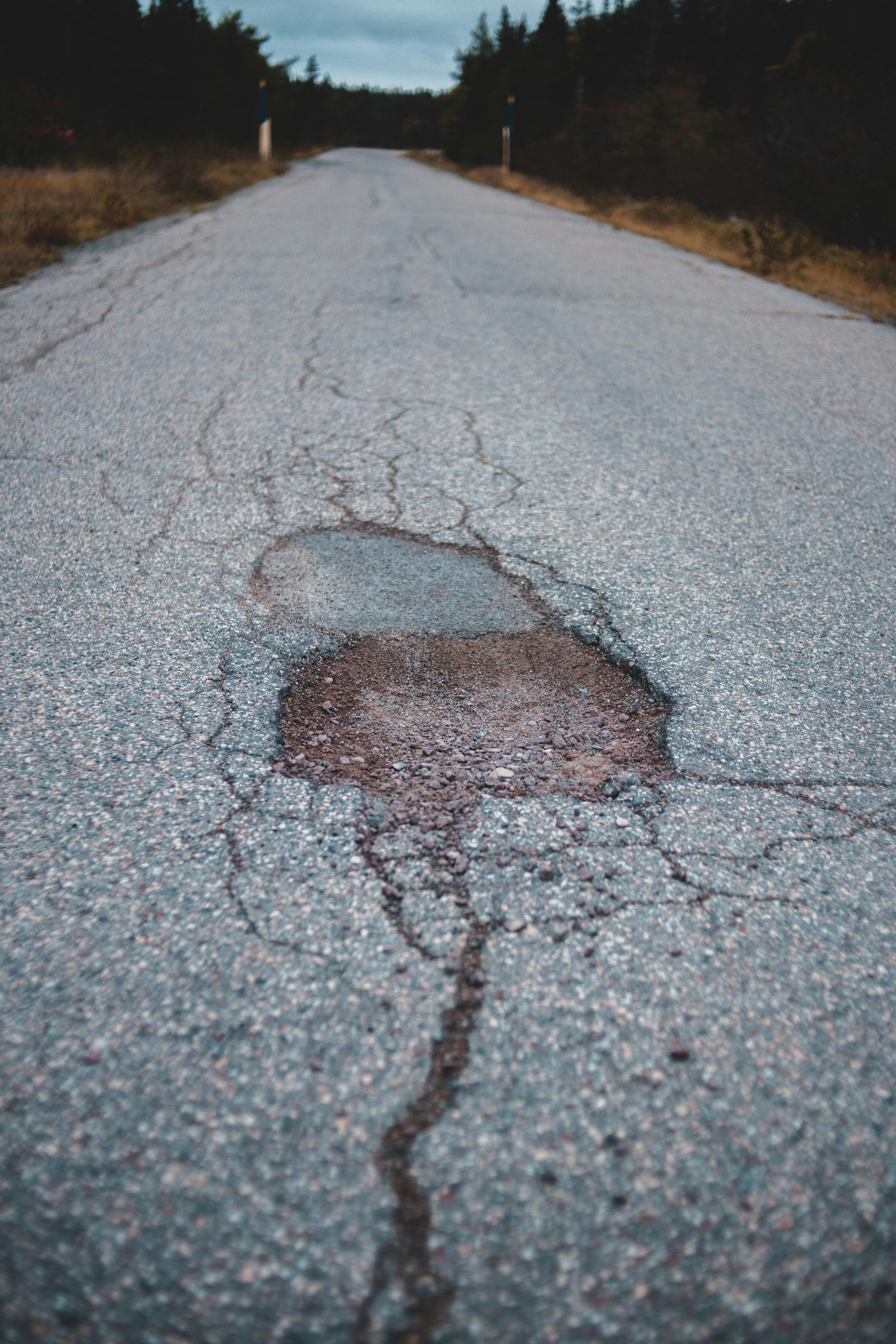
Potholes aren't accidents; they are the result of the freeze-thaw cycle. During a Georgia winter, water seeps into tiny cracks. When it freezes at night, it expands, pushing the asphalt up. When it thaws, it leaves a hollow void. As soon as a heavy vehicle drives over that void, the surface collapses.
In Atlanta, this is worsened by our clay. This soil is highly absorbent; when it thaws, it turns "spongy." When a truck passes over, it creates a pumping action, forcing wet mud up through cracks and hollowing out the foundation even further.
The "Fix it Twice" Penalty
If your lot has "alligator cracks" (interconnecting cracks that look like scales), your sub-base has already failed. Attempting an asphalt repair by simply applying a 'skin patch' over these areas is a false economy.
Because the underlying soil is unstable, the movement will break the new patch within a single season. You end up paying to fix the exact same spot twice. To truly solve the problem, you must remove the "sick" soil and replace it with a stabilized foundation.
The 20-Year Horizon: ROI of Preparation
Choosing a "cheap" bid that ignores dirt work is the most expensive mistake a manager can make. A lot built on stabilized soil can last 20–25 years, while one laid on raw clay may fail in 5–8 years.
r post goes here. To edit this text, click on it and delete this default text and start typing your own or paste your own from a different source.
| Feature | Stabilized Sub-Base (The Right Way) | Raw Clay Sub-Base (The "Cheap" Way) |
|---|---|---|
| Lifespan | 20–25 Years | 5–8 Years |
| Repair Frequency | Minimal (Sealcoat every 3–5 yrs) | High (Annual potholes) |
| Structural Integrity | Rigid and load-bearing | Spongy and prone to "pumping" |
Turning Clay into Concrete: The Engineering Solution
At The Paving Guys, we don't just "pave and pray." We use engineering to change the chemistry of the ground:
- Cement Stabilization: Mixing cement into the clay to turn it into a stone-like platform.
- Geotextile Fabrics: Installing high-strength grids that act like a "snowshoe," spreading vehicle weight.
- Compaction Testing: Using sensors to ensure the base is packed to maximum density.
Plan Your Defense
Don't let your maintenance budget disappear into a hole. Learn how to phase your repairs to protect your foundation without breaking your annual budget. Contact The Paving Guys today for a professional sub-base evaluation
Frequently Asked Questions
Why does my parking lot have "alligator cracks" even if I sealcoat it regularly?
As a leading Atlanta commercial paving service, we often see alligator cracks even on well-maintained lots. Alligator cracking is a sign of sub-base failure, not a surface issue. While sealcoating protects the top layer from UV rays and oil spills, it cannot reinforce a weak foundation. If the red clay beneath the asphalt is shifting or saturated, the pavement will crack regardless of how well the surface is maintained.
Is Georgia red clay really that different from soil in other states?
Yes. Georgia red clay is a "highly expansive" soil. It acts like a sponge, absorbing massive amounts of water and expanding. When it dries, it shrinks. This constant movement creates voids under the asphalt. In states with sandy or rocky soil, the foundation remains much more stable throughout the seasons.
What is the difference between a "skin patch" and a "deep-tissue repair"?
A skin patch (or "surface patch") just adds a thin layer of asphalt over an existing hole. It’s a temporary "band-aid." A deep-tissue repair involves digging out the failed asphalt and the soft clay beneath it, replacing it with compacted stone, and then paving. This fixes the root cause so the pothole doesn't return.
Can I save money by waiting until summer to fix spring potholes?
Waiting usually costs more. A small pothole in April allows rain to pour directly into the sub-base. By July, that water will have compromised a much larger area of the foundation, turning a $500 repair into a $5,000 structural failure. Early intervention is the key to protecting your ROI.
How long does a "stabilized" sub-base actually last?
When we use cement stabilization or geotextile grids, we are essentially turning the soil into a rigid platform. While standard "clay-base" lots might fail in 7 years, a stabilized foundation can easily support asphalt for
20 to 25 years with only minor surface maintenance.